
News Details
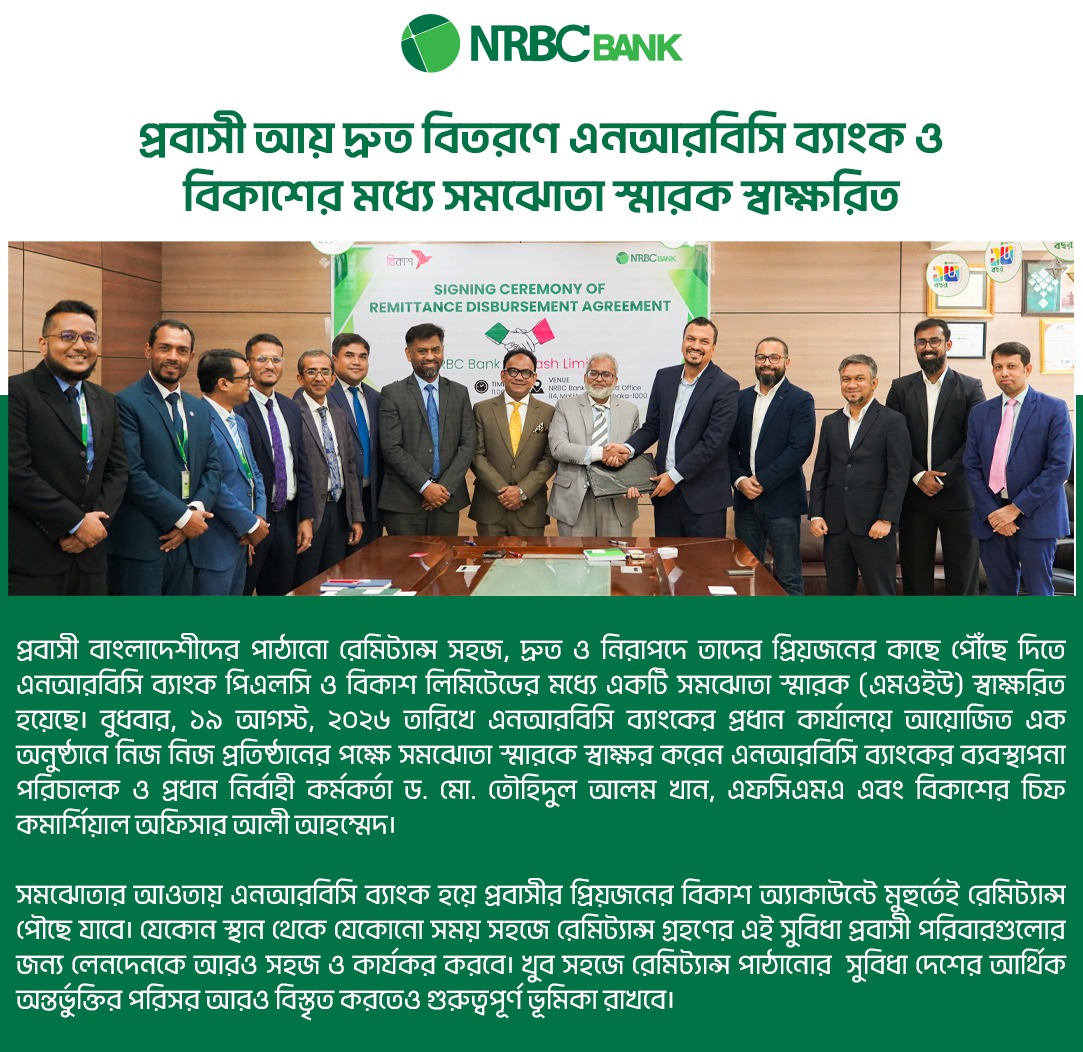
NRBC Bank PLC and bKash Limited have signed a Memorandum of Understanding (MoU) to facilitate the easy, fast, secure and instant distribution of remittances sent by Bangladeshi expatriates working across different countries. The MoU was formally signed on Wednesday, August 19, 2026, at NRBC Bank’s Head Office. On behalf of their respective organizations, the agreement was signed by Dr. Md. Touhidul Alam Khan, FCMA, Managing Director & CEO of NRBC Bank PLC and Ali Ahmmed, Chief Commercial Officer of bKash. Under the agreement, expatriates can send remittance to the relative’s bkash account instantly througe NRBC Bank PLC. As a result, remittance receivers will be able to use the money more conveniently and appropriately. People will be able to receive small-ticket remittances conveniently through formal banking channels, contributing significantly to the country’s broader financial inclusion. Among others, Mohammad Abdul Qaium Khan, Deputy Managing Director & COO of NRBC Bank; Md. Shaheen Howlader, Deputy Managing Director & CBO; Hasnat Reza Mohibbul Alam, Head of International Division, Rasedul Islam, FCMA. FCA, Chief Financial Officer (CFO), Md. Razidul Islam, Head of ICT Operations Division, Kazi Zunaid Zaman, Head of Treasury Division, Sayed Shaikh Ibna Jilany, Vice President (Remittance, Financial Services, Commercial) of bkash, Shouvik Ghosh, Vice President (Banking Partnership, Financial Services, Commercial) of bKash, Tanvir Mahmud, Manager (Remittances, Financial Services, Commercial) of bkash and senior officials from both organizations were present at the signing ceremony. Speaking on the occasion, Dr. Md. Touhidul Alam Khan, Managing Director & CEO of NRBC Bank PLC, said, “The use of technology has made the payment ecosystem significantly easier and more secure. This partnership between NRBC Bank and bKash will encourage expatriate Bangladeshis to send remittances through formal channels and ensure their greater participation in the country’s institutional economy.”